
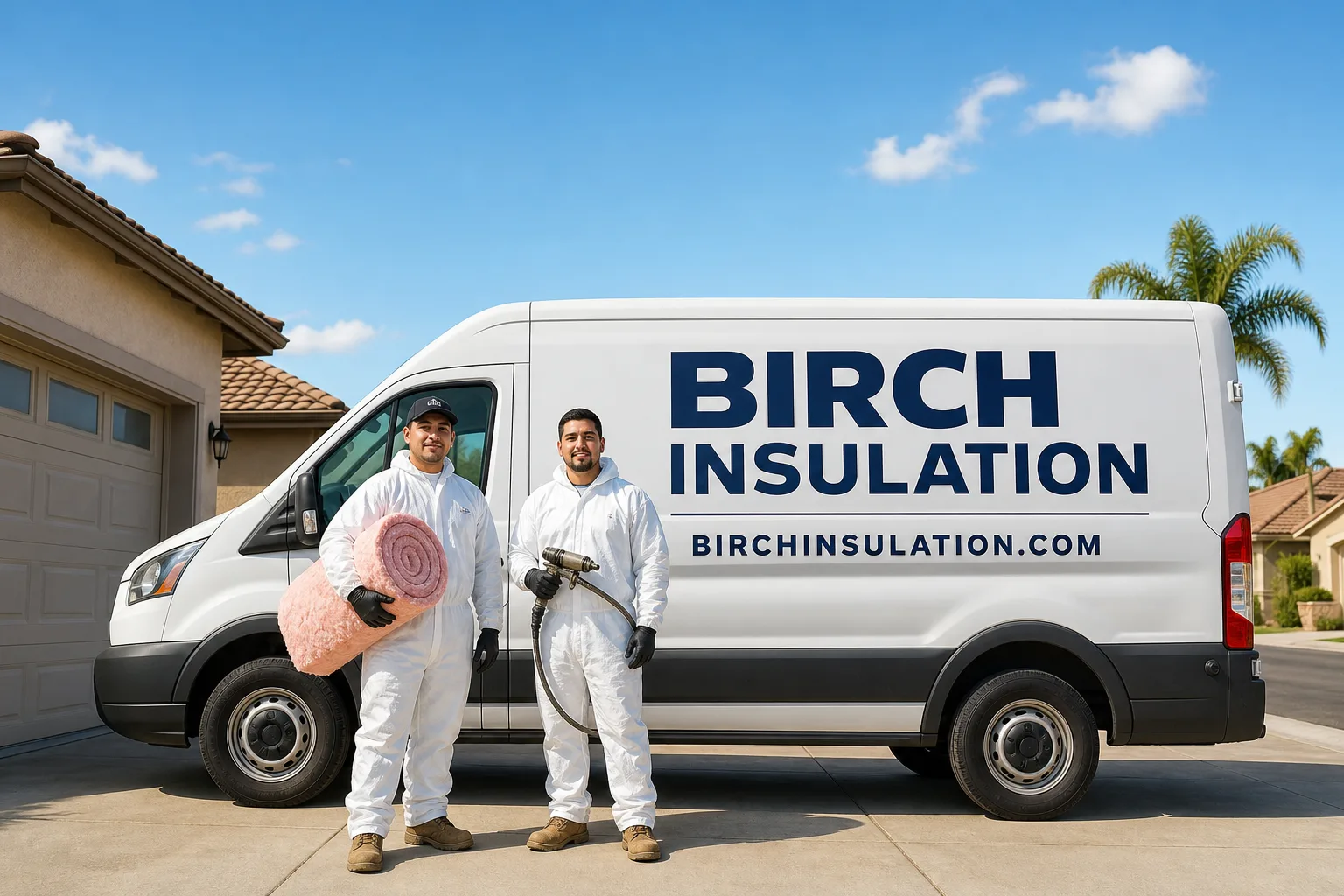
Fast, Reliable Spray Foam Insulation Across Lakeland Village
Spray foam insulation in Lakeland Village typically runs $2,100 – $6,800 depending on scope, with attic roofline jobs on older mobile homes landing between $2,400 and $4,200. Most projects in the 92530 zip code are completed in one to two days, and we schedule Lakeland Village calls within the same week in most cases. If your attic is baking past 140°F by early afternoon in July, or you can feel heat radiating through your ceiling by 3 p.m., that’s the problem spray foam is built to solve. Call (866) 511-7592 for a free estimate, and we’ll send someone who knows Lakeland Village’s housing stock specifically, because a mobile home off Grand Avenue needs a different approach than a stick-built house off Lakeshore Drive.
Why Birch Insulation Is Lakeland Village’s Preferred Spray Foam Insulation Company
We work in Lakeland Village regularly, which means we know what’s behind the walls and under the floors here before we even arrive. The mobile-home communities near the lake, the older single-family streets north of the 74, the stucco-and-frame homes from the 80s and 90s: each has its own failure pattern, and we’ve seen them all. Homeowners in Lakeland Village keep calling us back for the same reason they refer us to neighbors: we tell them what the job actually needs, not what’s easiest for the truck.
Nate Crowley runs the spray foam side of the business, and he’s the one who makes the call when a legacy insulation job turns into a retrofit. That experience matters here, because Lakeland Village homes rarely have a single clean problem. It’s usually a stack: sagging belly wrap, a low-pitch attic cooking at 140°F, and windows leaking air faster than the attic can be sealed.
We carry both Icynene and Demilec spray foam products, which matters if you’re weighing open-cell versus closed-cell for a roof deck or a rim joist. Most contractors push whatever foam they’re contracted to sell. We recommend the foam that fits the house, and we can explain the R-value, vapor-permeability, and cost tradeoffs in plain language before you commit to anything.
Spray Foam Attic Insulation in Lakeland Village
Spray Foam Attic Insulation is the highest-impact upgrade for Lakeland Village homes because the dominant problem here isn’t winter heat loss, it’s July and August heat gain. When your attic hits 130°F or 140°F by early afternoon, that heat doesn’t just sit in the roof cavity, it radiates down through the ceiling into the living space, making the AC run nonstop. Spray foam on the roofline creates an air seal and a thermal break that legacy batt insulation simply cannot match, especially in low-pitch attics where there’s barely room to crawl.
A typical spray foam attic job in Lakeland Village runs $2,400 – $4,200 for the roofline of a standard single-family or mobile home. The cost depends on square footage, roof pitch, whether we’re removing failed legacy batts first, and whether you need open-cell or closed-cell foam. Homes within walking distance of the lake often benefit from closed-cell because of the humidity near the water, even though this is technically a dry inland climate.
Low-Pitch Attic Sealing
Lakeland Village’s older mobile homes and 1960s-70s single-family stock often have roof pitches too shallow for blown-in insulation or even comfortable crawl space access. Spray foam solves this because it’s applied directly to the underside of the roof deck, no crawl space required. The foam expands and seals every seam, gap, and penetration in one pass.
Heat-Load Reduction for Older Homes
If your home in Lakeland Village still has original fiberglass batts in the attic, they’ve probably been settling and degrading in 100°F-plus heat for decades. Fiberglass loses effectiveness when it compresses or gets dusty, and it doesn’t stop radiant heat transfer the way a continuous foam seal does. We typically see a measurable drop in afternoon indoor temperatures after a roofline spray foam application, even before the AC catches up.
Spray Foam Wall Insulation in Lakeland Village
Spray Foam Wall Insulation in Lakeland Village is the answer when a home’s envelope is leaking from every seam: single-pane windows, aluminum frames, uninsulated wall cavities, and rim joists that were never sealed. In a hot-summer climate like this one, wall insulation matters less than attic insulation for cooling loads, but it still matters, especially on west- and south-facing walls that catch intense afternoon sun. If a wall faces the lake, the moisture-driven summer humidity can also make fiberglass or cellulose damp and ineffective over time.
Wall spray foam in Lakeland Village typically costs $1,800 – $3,600 for a single exterior wall or rim joist retrofit, with full-home wall injection running higher depending on access. The price hinges on whether we’re working from the outside, from the inside, or through the rim joist from the crawl space. Many older homes along Lakeshore Drive and the surrounding streets have wall cavities that are completely empty, and the difference after sealing is immediate, especially when the Santa Anas blow dry, hot air through every gap.
Rim Joist and Crawl Space Sealing
The rim joist is the wooden band around the perimeter of your house where the foundation meets the floor framing, and it’s a major air leak in Lakeland Village’s raised-foundation and mobile-home stock. We spray closed-cell foam along the rim joist to close off the chimney effect that pulls hot outside air into the crawl space and up through the floors. This is especially effective in the mobile-home parks near the lake, where skirting and underfloor access make the problem visible the moment you look.
Retrofit Walls in Older Inland-Valley Homes
The 1970s-1990s homes in Lakeland Village often have 2×4 framing with no wall insulation at all, which is hard to fix after the drywall is up. Spray foam injection through small holes in the wall cavity is the cleanest retrofit option, and it air-seals while it insulates. If we’re already doing attic work, adding wall or rim joist foam usually costs less than doing it as a standalone job.
Trusted Brands We Service in Lakeland Village
We stock Icynene and Demilec open-cell and closed-cell foam for Lakeland Village jobs, and we keep enough material on hand to avoid the two-week supplier delays that hit other contractors. Demilec closed-cell makes sense when you need high R-value per inch on a low-pitch roof deck or a rim joist, while Icynene open-cell is often the better fit for wall cavities and interior sound control. Because we’re not tied to one manufacturer, we can recommend the foam that matches your home’s construction and your budget rather than the foam that’s already on our truck. If you’re weighing spray foam against GreenFiber cellulose or an Owens Corning batt system, we’ll walk you through the cost and performance tradeoffs before you decide. Spray Foam Insulation done right starts with the right material, and that’s a decision we make with you, not for you.
Common Spray Foam Insulation Problems We See in Lakeland Village Homes
- Low-pitch attics cooking at 140°F+ in July. Older mobile homes and 1960s-era single-family roofs in Lakeland Village aren’t vented well enough to shed summer heat. Legacy batts bake and degrade, and the radiant heat pours through the ceiling while the AC fights a losing battle.
- Rodent-torn underbelly insulation below mobile homes. In the mobile-home communities near the lake, we routinely find factory belly wrap sagging or shredded where rodents have worked through the skirting. The vapor barrier fails from below, and no amount of attic foam fixes the problem until the underbelly is repaired.
- Single-pane windows leaking faster than the attic can be sealed. The older inland-valley homes in Lakeland Village often still have original single-pane or aluminum-frame windows, and they leak conditioned air year-round. That undercuts the performance of any spray foam job, which is why we talk about the whole envelope, not just the roof.
- Failed or missing rim joist insulation. Homes on raised foundations near the lake lose cooling through the rim joist, especially when dry Santa Ana winds press hot air into the crawl space. We see this on nearly every older Lakeland Village house we inspect, and the fix is straightforward closed-cell foam.
Pricing for Spray Foam Insulation in Lakeland Village, CA
Here’s what we’re quoting in Lakeland Village right now. A full roofline spray foam job on a standard single-family home runs $2,400 – $4,200. A mobile home attic or low-pitch roof deck runs $2,100 – $3,400 depending on square footage and access. Wall cavity retrofit spray foam runs $1,800 – $3,600 per exterior wall or rim joist set. If you’re combining an attic job with a belly-wrap repair on a mobile home, expect $4,500 – $6,800 total. These are honest ranges, not teaser numbers: cost moves with square footage, foam type, and the condition of whatever legacy insulation we’re removing or working around. Call (866) 511-7592 for a free estimate, and we’ll give you a fixed number before any work begins, not a vague range that changes after we show up.
We Also Serve Cities Near Lakeland Village
Our Lakeland Village crews also cover Lakeland Village neighbors in Sedco Hills, Canyon Lake, Meadowbrook, and Wildomar. If you’re just outside the 92530 zip code and your attic is cooking in the inland heat, call us and we’ll let you know if we can get there this week. Most of these areas share the same hot-summer, dry-wind pattern, so the solutions carry over directly.
Serving Lakeland Village, CA — Our Local Coverage Area
We’re based in the Lakeland Village area and know this community well. Use the map below to see our service coverage — if you’re nearby, we can almost certainly help.
FAQs About Spray Foam Insulation in Lakeland Village
Yes, but only if the underbelly is addressed at the same time. A mobile home in Lakeland Village with thin factory insulation and a sagging or rodent-torn belly wrap will not hold conditioned air no matter what we spray in the attic. The right sequence is: repair and re-set the belly wrap with a new vapor barrier, seal any rodent breaches in the skirting, then spray closed-cell foam along the roofline to cut the heat load. Skip the belly work and you’re paying for foam that can’t do its job. Call (866) 511-7592 and we’ll tell you if your underbelly is even a factor before you commit to an attic job.
Because Lakeland Village’s problem is heat gain, not heat loss. Big Bear homes are sealing against cold winters and deep snow, but in Lakeland Village the attic is a solar oven most of the year. Low-pitch roofs, intense afternoon sun, and long stretches over 100°F mean the priority is keeping radiant heat out of the living space. Spray foam on the roofline does that far better than fiberglass batts, which primarily slow conductive heat transfer and do almost nothing for radiant heat.
Yes, and it’s usually the only practical option in the older mobile homes and 1960s-70s houses around the lake where the attic is too shallow for blown-in insulation. We spray directly on the underside of the roof deck, which seals the roofline and turns the attic into conditioned space. In a low-pitch Lakeland Village attic, this also eliminates the venting problem, because a 140°F attic with poor airflow is exactly what spray foam is designed to neutralize. Call (866) 511-7592 for a roofline assessment.
They don’t change the spray foam price, but they change what you’ll feel after the job. Single-pane and aluminum-frame windows leak so much air that even a perfectly sealed attic and rim joist won’t stop the drafts or the heat transfer through the glass. We’ll still quote the foam job fairly, but we’ll also tell you honestly if your windows are going to undercut the result, because in Lakeland Village’s older inland-valley stock, that’s often the case. Call (866) 511-7592 and we’ll walk the house with you before we write anything up.
Repair first, retrofit second. If the legacy batts are wet, rodent-damaged, or compressed to the point of failure, spraying over them just traps the problem. We remove or repair the damaged material, fix the moisture or pest entry point, and then spray foam onto a clean, dry surface. The exception is mobile-home underbelly insulation: we repair the belly wrap and vapor barrier from below before any attic foam goes in. The sequence matters more than the product, and in Lakeland Village’s older homes, skipping the repair step is how people end up with a $5,000 spray foam job that doesn’t change their energy bill.
Written by Nate Crowley, Owner at Birch Insulation, serving Lakeland Village since the company’s founding in Rialto, CA.