Attic Insulation Cost Guide: What Rialto Homeowners Pay in 2026
Most Rialto homeowners will pay between $1,800 and $6,200 to insulate a standard attic in 2026, depending on the material and the home’s existing condition. Blown fiberglass runs $1.10 to $1.80 per square foot installed, blown cellulose $1.30 to $2.00, open-cell spray foam $2.50 to $4.00, and closed-cell foam $3.50 to $6.50. If you’d rather skip the math and get a straight number for your house, call (866) 511-7592 and we’ll walk you through it.
Here’s the thing about that $1.50-per-square-foot figure you see on every national cost guide: it wasn’t calculated in San Bernardino County. Rialto’s labor market, our older housing stock, and the rebate programs available through SCE and SoCalGas all shift the real numbers. We’ve seen homeowners reject accurate bids as overpriced because a website told them insulation should cost half of what it actually does out here. This guide fixes that.
What Attic Insulation Actually Costs in Rialto in 2026
The national average for attic insulation sits around $1.50 per square foot installed. That number assumes a clean, empty attic, no air sealing, no old insulation removal, and labor rates from the Midwest. None of those assumptions hold in Rialto. We regularly see final installed costs land 30% to 40% above national guides once the real work is accounted for.
Here are realistic 2026 installed ranges for a 1,200-square-foot attic in Rialto:
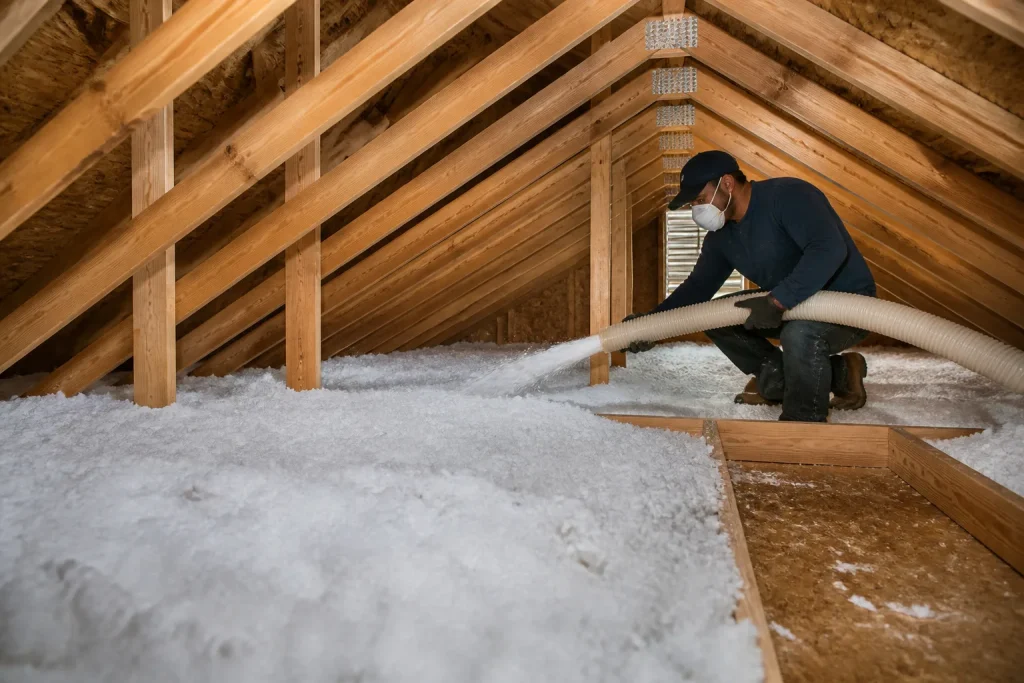
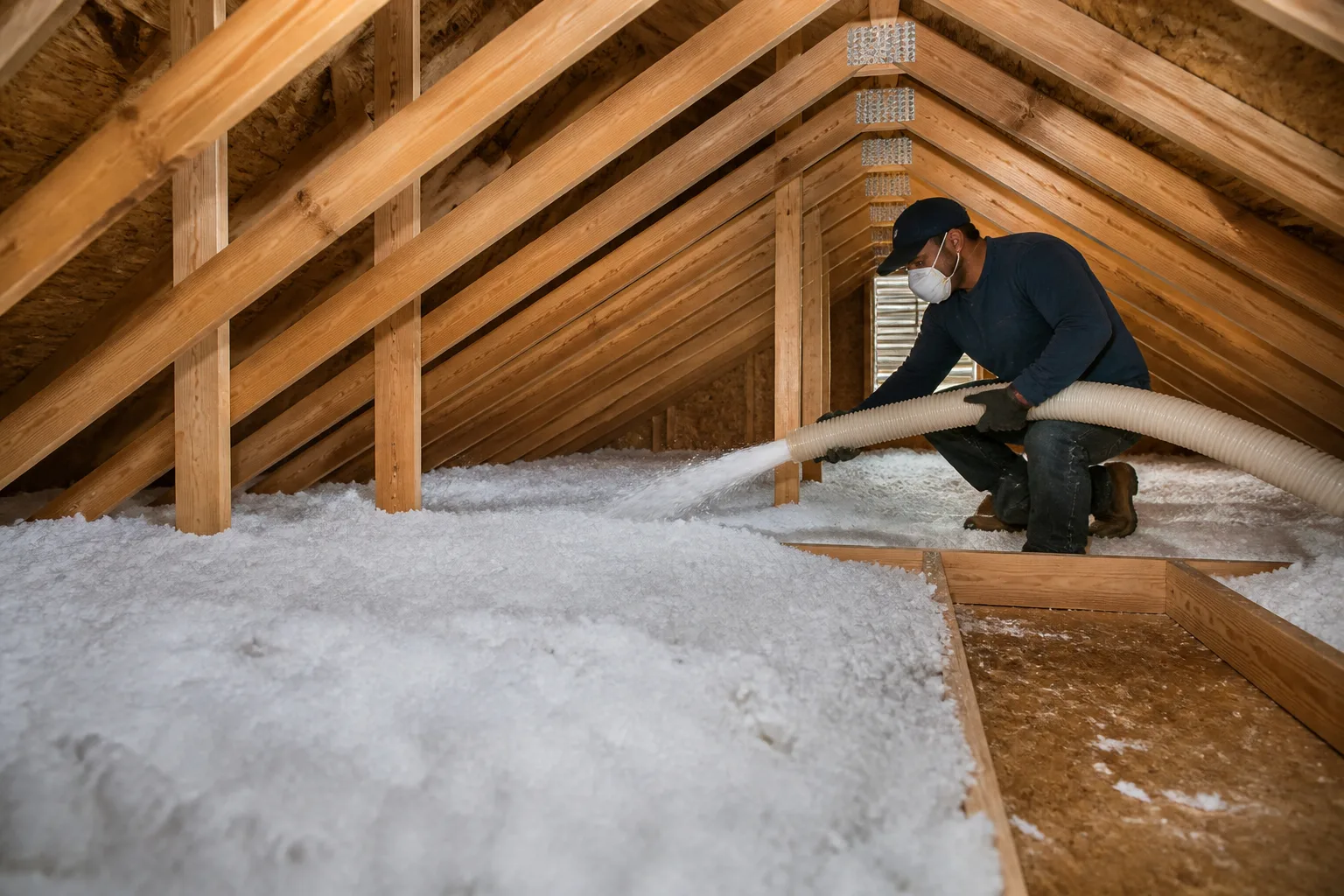
- Blown fiberglass (R-38): $1,300 to $2,200 installed. Fast, affordable, and the most common choice for open attics. We pull Owens Corning, Johns Manville, Knauf, and CertainTeed products depending on availability and your home’s specifics.
- Blown cellulose (R-38): $1,600 to $2,400 installed. GreenFiber cellulose costs slightly more per bag but fills irregular cavities better and carries a higher recycled content, which matters to some Rialto homeowners.
- Open-cell spray foam (R-21 at roof deck): $3,000 to $4,800 installed. Seals air as well as it insulates, which makes it the right call for attics with ductwork running through them.
- Closed-cell spray foam (R-28 at roof deck): $4,200 to $7,800 installed. Highest R-value per inch and adds structural rigidity, but it’s the premium option and not every Rialto home needs it.
Square footage matters, but so does depth. R-38 is the code minimum for attic floors in our climate zone, but R-49 is what we recommend for anyone planning to stay in their home more than five years. That upgrade typically adds $400 to $700 for a standard attic.
The Hidden Line Items That Inflate Rialto Quotes
When two Rialto contractors quote the same attic at $2,900 and $4,400, the difference is almost never markup. It’s scope. The lower bid is usually skipping work the higher bid includes. Here’s what you’re actually paying for when the quote looks high:
- Air sealing (non-negotiable): $300 to $700. Before we blow insulation, we seal the gaps around recessed lights, plumbing penetrations, and top plates. Skipping this step is like putting on a winter coat with the zipper broken.
- Old insulation removal: $1 to $2 per square foot. If your Rialto home was built before 1990, that attic insulation may contain vermiculite or be too compacted to insulate properly. Rodent damage is also common in older Inland Empire neighborhoods, and that material has to come out first.
- Eave baffling: $2 to $4 per baffle, typically 12 to 20 baffles per attic. These keep your soffit vents open when insulation is piled against the roofline. Cheap line item, expensive problem if skipped; you’ll get moisture issues.
- Permit fees: $100 to $300 in Rialto depending on project scope. Some contractors skip permits to keep bids low. That’s a liability you don’t want.
We’ve walked into attics where a previous “affordable” job had blown R-19 right over unsealed can lights. The homeowner was paying SCE rates to heat their attic. Air sealing is the cheapest line item on a quote and the most important one to get right.
How SCE and SoCalGas Rebates Cut the Real Cost
Southern California Edison and SoCalGas both run residential energy-efficiency programs in 2026 that can offset a meaningful chunk of your attic insulation cost. The exact rebate depends on your current R-value, your home’s square footage, and whether you’re upgrading or installing from scratch.
The tiered structure works like this:
- Tier 1: Bringing an attic from R-0 to R-38 qualifies for a base rebate, typically $0.15 to $0.25 per square foot through SCE’s Home Energy Upgrades program.
- Tier 2: Going from R-11 or below up to R-49 or higher unlocks the higher tier, often $0.35 to $0.50 per square foot.
- SoCalGas bonus: Homes with gas heating may qualify for an additional rebate when attic insulation is combined with duct sealing or other measures.
For a 1,200-square-foot Rialto attic going from minimal insulation to R-49, rebates can knock $400 to $700 off the final bill. These programs change frequently, and eligibility depends on your home’s specific energy profile. We help Rialto homeowners file for these rebates as part of the estimate process, but here’s the honest version: some homes qualify, some don’t, and the rebate should be treated as a bonus, not a budget line.
Why the Lowest Bid Is Usually the Most Expensive Outcome
A contractor who comes in 25% below the rest of the field isn’t more efficient. He’s skipping something. In Rialto, where much of the housing stock is 40 to 70 years old, what gets skipped usually falls into one of these categories:
- No air sealing: The insulation gets blown in over a leaky attic floor. Your energy bill barely moves, and now you’ve paid for insulation that isn’t doing its job.
- Undersized depth: R-30 instead of R-38. Looks fine on day one. Costs you $180 to $300 per year in extra cooling load through every Rialto summer.
- No vapor barrier consideration: In our climate, moisture moves from the living space up into the attic. Get this wrong and you’re looking at mold in the drywall within a few years.
- Subcontractor labor: The low bid brings in a crew that does gutters one week and insulation the next. We handle attic insulation, blown-in work, and spray foam in-house, so the crew that quotes your job is the crew that does it.
We pulled a GreenFiber cellulose job out of a home near Rialto High last year where the previous contractor had achieved “R-38” by blowing six inches in the center of the attic and two inches at the eaves. The homeowner’s upstairs bedroom was 12 degrees warmer than the rest of the house. The fix cost more than the original job.
How to Compare Insulation Quotes Apples to Apples
Here’s the unit most cost guides don’t tell you about: price per R-value per square foot. It’s the only way to genuinely compare different materials at different depths.
The formula is simple. Take the total installed price, divide by the square footage, then divide by the R-value. A $2,400 blown fiberglass job at R-38 over 1,200 square feet works out to about $0.053 per R per square foot. A $4,500 open-cell foam job at R-21 over the same area runs $0.179 per R per square foot.
That doesn’t mean fiberglass is always the right call. Spray foam air-seals as it installs, so you’re buying two jobs in one. Closed-cell foam adds structural strength and blocks moisture in ways fiberglass never will. We carry Icynene and Demilec spray foam precisely because the open-cell versus closed-cell decision matters for Rialto’s specific climate, and having both under one roof means we recommend the one your home actually needs.
When you’re comparing quotes, ask every contractor the same three questions:
- Does this include air sealing? If not, what’s the price to add it?
- What R-value am I getting, measured at the thinnest point, not the deepest?
- Are you handling permits, rebate filing, and the in-house crew?
If a contractor can’t answer those three clearly, the price on the quote doesn’t matter.
When to Call a Pro
Attic insulation is one of those projects that looks simple and rarely is. Pulling out old fiberglass batts in a 140-degree Rialto attic in July is miserable work, but that’s not the reason to call someone. The reason is that the mistakes are invisible. You won’t know you skipped air sealing until your August SCE bill arrives. You won’t know the depth is uneven until winter when your ceiling develops condensation stains. A professional insulation crew catches these things before they become problems you can see.
If you’re in Rialto and want a straight answer on your attic, we offer free estimates with no obligation. Our Attic Insulation in Rialto service covers full material-matched recommendations across fiberglass, cellulose, mineral wool, and spray foam. If your home is a candidate for Spray Foam Insulation in Rialto, we’ll tell you why and what it costs. For older homes with settled insulation, Blown In Insulation in Rialto is often the most cost-effective path to R-49.
The Bottom Line
Rialto attic insulation costs more than the national averages suggest, and that’s not a contractor conspiracy. It’s the reality of our labor market, our older homes, and the prep work that’s genuinely necessary to do the job right. Budget $1,800 to $6,200 depending on material, and remember that the cheapest bid usually costs the most in the long run. Rebates through SCE and SoCalGas can help, but don’t build your budget around them.
If you’re in Rialto and need help sorting through the options, Birch Insulation offers free estimates. Call (866) 511-7592 and we’ll give you a straight number for your specific attic, not a square-foot average from a national website.
Frequently Asked Questions
For a 1,200-square-foot attic in Rialto, expect to pay $1,300 to $2,400 for blown fiberglass or cellulose at R-38, or $3,000 to $7,800 for spray foam depending on open-cell versus closed-cell. Air sealing, old insulation removal, and baffling will add to the total if needed. Call (866) 511-7592 for a free estimate on your specific home.
Yes. Rialto summers routinely push attic temperatures past 150 degrees, and that heat radiates into your living space all day. Proper R-38 to R-49 attic insulation typically pays for itself in 3 to 7 years through reduced cooling costs alone, and it makes upstairs rooms noticeably more comfortable.
Blown fiberglass and cellulose last 20 to 30 years before settling starts to reduce performance. Spray foam can last the life of the home. In Rialto’s dry climate, the bigger issue is often rodent damage or roof leaks compacting the material, which is why removal and replacement is common in older homes.
Remove old insulation if it’s been damaged by rodents, water, or contains vermiculite from pre-1990 construction. If the existing material is clean and just under-insulated, blowing new insulation on top is usually fine and costs less. A visual inspection tells you which situation applies. Call (866) 511-7592 to schedule one.
Written by the team at Birch Insulation, serving Rialto since 2015.
Need Insulation Help?
Call Birch Insulation — licensed & insured, here with fast after-hours help in Rialto.
(866) 511-7592