
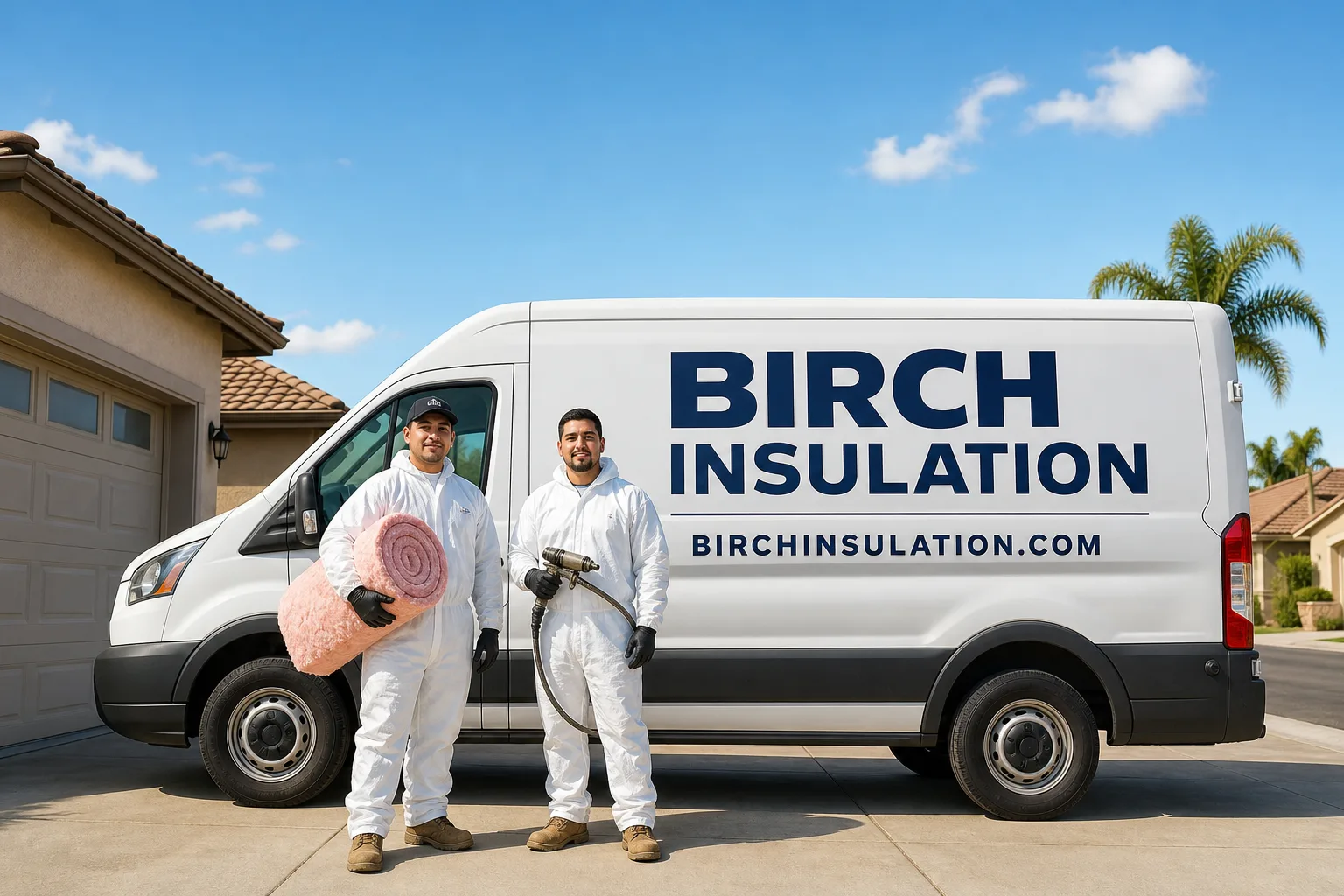
Fast, Reliable Attic Insulation Across Azusa
If your Azusa home runs hot upstairs in August and cold in January, the attic is usually the culprit. Most attic insulation jobs in Azusa take one day, and we schedule within 3 to 5 business days of your call. Birch Insulation handles everything in-house: blown-in fiberglass, cellulose, spray foam, batts, and full removal when old material has failed. We know the 91702 housing stock well, and we know what canyon winds do to attics here. Call (866) 511-7592 for a free estimate and we’ll tell you exactly what your attic needs and what it’ll cost.
Why Birch Insulation Is Azusa’s Preferred Attic Insulation Company
We’ve worked in enough Azusa homes to know the patterns before we even climb the ladder. The 1950s tract houses north of Foothill Boulevard, the 1970s ranchers east of Azusa Avenue, the newer infill near the Citrus Edge corridor: each era of construction has its own attic quirks. Nate Crowley built Birch Insulation around a simple idea: carry enough manufacturers to match the material to the house, not the other way around. That means we stock Owens Corning, Johns Manville, GreenFiber, and Demilec products, and we’re not married to any of them. If your Azusa home needs R-49 blown fiberglass, we’ll say so. If spray foam is the right call for a cathedral ceiling, we’ll say that too.
Response time to Azusa is straightforward. We dispatch from Rialto, and most Azusa appointments happen within the same week. We don’t subcontract. The crew that quotes your job is the crew that installs it.
Attic Mold Removal in Azusa
Attic Mold Removal in Azusa homes is a job we handle more often than most people expect, and the cause is usually the same: poor ventilation meeting moisture from bathroom exhaust fans that terminate inside the attic. Older Azusa tract homes were built with minimal ridge and soffit venting, and when bathroom fans dump humid air into a hot, poorly vented attic, mold takes hold on the underside of the roof deck. The fix starts with ventilation correction – adding baffles, ensuring soffit intake isn’t blocked by old insulation – then removing mold-affected material and treating the framing. In Azusa, attic mold removal typically runs $1,200 to $3,800 depending on square footage and how far the growth has spread. The mold isn’t the root problem; trapped moisture is. We treat both, or the mold comes back.
Ventilation Correction Before Treatment
You can’t remove mold from an Azusa attic and call it done if the attic still can’t breathe. We inspect ridge vents, soffit vents, and gable vents first. In many 1950s and 60s homes here, soffit vents were never installed or got buried under decades of blown insulation. We clear them, add baffles where needed, and then address the mold.
When Removal Becomes Replacement
If mold has penetrated the roof sheathing more than surface-deep, sanding and treating may not be enough. In some Azusa homes we’ve seen mold colonies that have worked into the plywood itself. At that point we recommend partial sheathing replacement along with mold treatment. We’ll show you photos from the attic so you can see exactly what we’re seeing, then let you decide.
Attic Insulation Removal in Azusa
Attic Insulation Removal in Azusa is a specific job we do before mold treatment, before vermiculite testing, or before a full re-insulation when the old material has failed. In Azusa’s older tract homes from the 1950s and 60s, we commonly find thin original fiberglass batts that have compacted to half their rated R-value, or loose-fill that has been blown into drifts by canyon winds and left bare patches on the north-facing slopes. Removal involves vacuuming out the old material with commercial HEPA-filtered extraction equipment, bagging it, and prepping the attic for new insulation. For a typical 1,200 to 1,800 square foot Azusa home, insulation removal alone runs $1.50 to $2.50 per square foot, so most jobs land between $1,800 and $4,500. It’s the right call before mold treatment, after a rodent infestation, or when old material is too compacted to top off.
Hepa Extraction Keeps the House Clean
We use truck-mounted HEPA extraction, not a shop vac. The hose runs directly from the attic to the truck, so no dust cycles back through the living space. For Azusa homeowners with allergies or kids, that matters.
Before a Top-Up, Check What’s Under the Old Material
Some Azusa attics hide surprises under the old insulation: knob-and-tube wiring, vermiculite, or old can light fixtures that aren’t IC-rated. We inspect before recommending a top-up. Adding new insulation over unsafe wiring or non-IC-rated cans is a fire hazard, and we won’t do it. That’s a conversation we have regularly in this city’s older homes.
Trusted Brands We Service in Azusa
We carry and install products from Owens Corning, Johns Manville, and GreenFiber, plus spray foam from Demilec. For Azusa attics, our most common spec is Owens Corning blown fiberglass at R-49 for vented attics, but GreenFiber cellulose is a better fit for some older homes because it fills irregular joist bays and slows air movement better than batts. If you’re in an Azusa home with a vaulted ceiling or a bonus room over the garage, Demilec closed-cell spray foam often makes more sense than anything blown. We stock materials for all three systems and can usually quote your job without a second visit. The point is this: we’re not a one-brand shop. What your attic gets is what your attic needs.
Common Attic Insulation Problems We See in Azusa Homes
- Wind-scoured insulation on north-facing slopes. Canyon Santa Ana winds push loose-fill across joist bays, leaving bare drywall on the windward side. We check north-facing attic slopes before quoting any job because a simple top-off won’t fix a drift problem.
- Compacted 1950s and 60s fiberglass batts. Original batts in Azusa’s postwar tract homes have often settled to R-11 or worse. The paper facing tears, the batts shift, and what’s left isn’t doing much. Removal and re-insulation is usually the more honest fix.
- Vermiculite in pre-1970 attics. Some Azusa homes still have loose vermiculite insulation, which may contain asbestos. We don’t disturb it until it’s tested. If testing comes back positive, we refer to a licensed asbestos abatement contractor before we touch the attic.
- Unsealed can lights and top plates. Wind-driven air leaks at ceiling penetrations make insulation perform worse than its R-value suggests. In Azusa, where Santa Anas push air through every gap, air-sealing matters as much as insulation depth.
Pricing for Attic Insulation in Azusa, CA
Blown-in fiberglass attic insulation for a typical Azusa home runs $2,800 to $5,500, depending on square footage and current R-value. Attic batt insulation replacement lands in the $1,800 to $4,200 range for standard 1,200 to 1,800 square foot homes. A top-up over existing insulation costs $1,200 to $2,800. If the attic needs full removal first, add $1,800 to $4,500. Attic mold removal runs $1,200 to $3,800. These are real numbers for the 91702 market, not national averages. Factors that shift the price: attic accessibility, the condition of existing insulation, whether baffles and air-sealing are needed, and whether you choose fiberglass, cellulose, or spray foam. Call (866) 511-7592 and we’ll give you a written quote after one visit.
We Also Serve Cities Near Azusa
Beyond Azusa, our crews regularly work in neighboring foothill communities like Citrus, Irwindale, Covina, and Glendora. The housing stock is similar: postwar tract homes, vented attics, original insulation that’s well past its service life. If you’re in one of those cities and your attic hasn’t been touched in decades, the same issues apply. Our Attic Insulation team covers the same service area with the same in-house crew.
Serving Azusa, CA — Our Local Coverage Area
We’re based in the Azusa area and know this community well. Use the map below to see our service coverage — if you’re nearby, we can almost certainly help.
FAQs About Attic Insulation in Azusa
Santa Ana winds funnel down the San Gabriel Canyon and press against your attic through vents and gable openings. Over time, loose-fill insulation drifts away from the windward side, leaving bare drywall on north-facing slopes. We fix this by air-sealing the attic against wind intrusion, then installing blown insulation that resists drifting, or in severe cases, switching to batts on the windward slopes. Call us for an assessment – we’ll check the north-facing slopes specifically.
Only if the old batts are dry, intact, and not compressed, and only if there’s no mold, vermiculite, or unsafe wiring underneath. In most 1950s Azusa homes, the original batts are compacted, torn, or wind-scoured, and adding insulation over them seals in the problem rather than fixing it. We’ll tell you honestly which path makes sense after we inspect the attic.
Santa Anas create positive pressure on the windward side of your home, driving air through vents, can lights, top plates, and any gap in the ceiling plane. That moving air strips heat from the insulation’s surface and makes it perform far below its rated R-value. The fix in Azusa is air-sealing first, then insulation. Without air-sealing, even new R-49 insulation won’t deliver full performance.
Don’t disturb it. Don’t store boxes in the attic, don’t run new wiring through it, and don’t let anyone blow insulation over it without testing. Vermiculite in pre-1970 Azusa homes may contain asbestos. Get a sample tested by a certified lab. If it’s positive, a licensed asbestos contractor handles removal. Then we come in and re-insulate properly. Happy to walk you through the process.
If the existing insulation is compressed, moldy, water-damaged, vermiculite, or has been blown into drifts with bare patches, removal is the right call. If it’s dry, reasonably even, and just below target R-value, a top-up works and costs less. In Azusa homes with wind-scoured north slopes, we often recommend removal on those slopes and top-up elsewhere. One attic inspection settles it.
Written by Nate Crowley, Owner at Birch Insulation, serving Azusa and the San Gabriel Valley.