
Demilec Attic Insulation in Rialto: A Homeowner’s Guide
Demilec attic insulation in Rialto typically costs between $2.50 and $4.75 per square foot installed for open-cell foam, with closed-cell running $3.50 to $6.50, depending on the roof deck configuration and depth required. That’s a significant premium over blown-in fiberglass or cellulose, so the real question isn’t whether Demilec works, it’s whether your specific Rialto attic justifies the cost. We carry Demilec as one of eight manufacturers on our trucks, which means we’ll tell you straight when it’s the right material and when it isn’t. If you’d rather skip the research and get an honest recommendation, call (866) 511-7592.
What Makes Demilec Different From Commodity Spray Foam
Spray foam is not a single product, and Demilec’s chemistry separates it from the generic foam some contractors buy by the drum. The two formulations that matter for Rialto attics are open-cell and closed-cell, and they solve different problems.
Demilec’s open-cell foam (their Heatlok HFO line and similar products) expands roughly 100 times its liquid volume and remains semi-flexible after curing. That flexibility matters in a climate like Rialto’s, where daytime highs in August push attic temperatures past 140°F and winter nights occasionally dip near freezing. The foam has to move with the framing as it expands and contracts. An air-sealing foam that cracks away from rafters within three years isn’t insulation, it’s decoration.
The more significant distinction is yield consistency. Off-brand closed-cell foams can deliver less cured volume per board foot than the label claims when applied in suboptimal conditions. Demilec’s closed-cell formulations (like their Sealection 500) cure more predictably across a wider temperature window. For Rialto homeowners doing a winter install, that’s meaningful: we can apply Demilec closed-cell on a 40-degree January morning and trust the final R-value per inch rather than overcompensating for drift.
Closed-cell Demilec also acts as a structural air barrier at the roof deck, which open-cell foam and batts do not. That distinction drives most of the decision framework below.
The Unvented Attic Case: When Demilec Closed-Cell Earns Its Cost
Here’s the scenario we see over and over in Rialto homes built between roughly 1970 and 2010: the HVAC system sits in the attic, with flex ducts snaking through unconditioned space that hits 130°F by noon in July. The homeowner pays to cool air that immediately gets reheated by the attic before it reaches the bedroom registers. Adding R-38 fiberglass to the attic floor does almost nothing for the ducts, because the ducts live above that insulation in the hot zone.
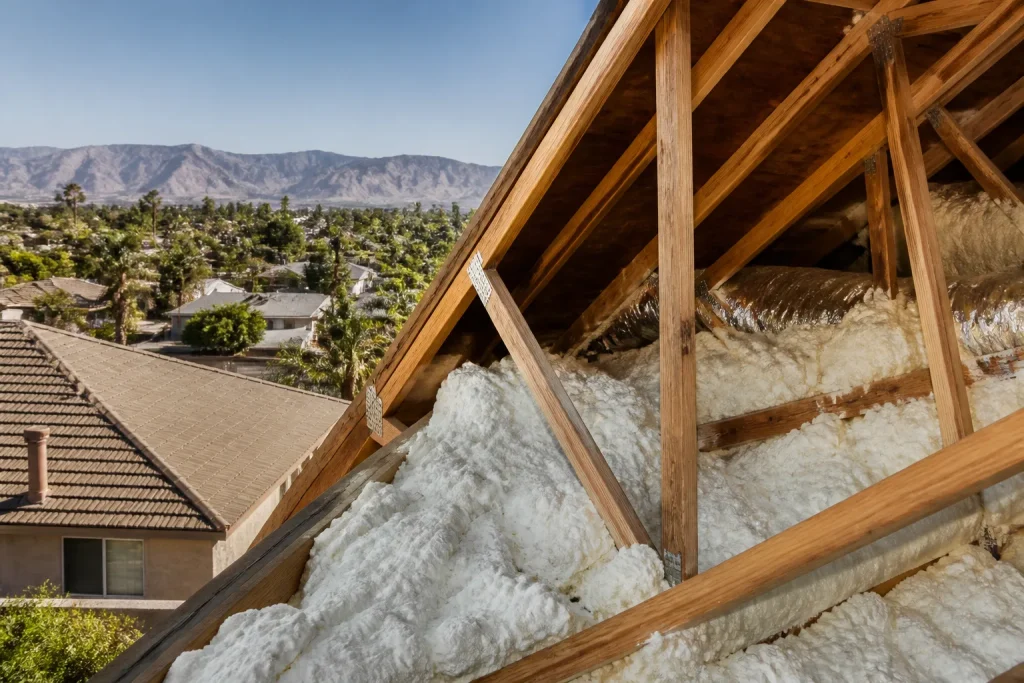
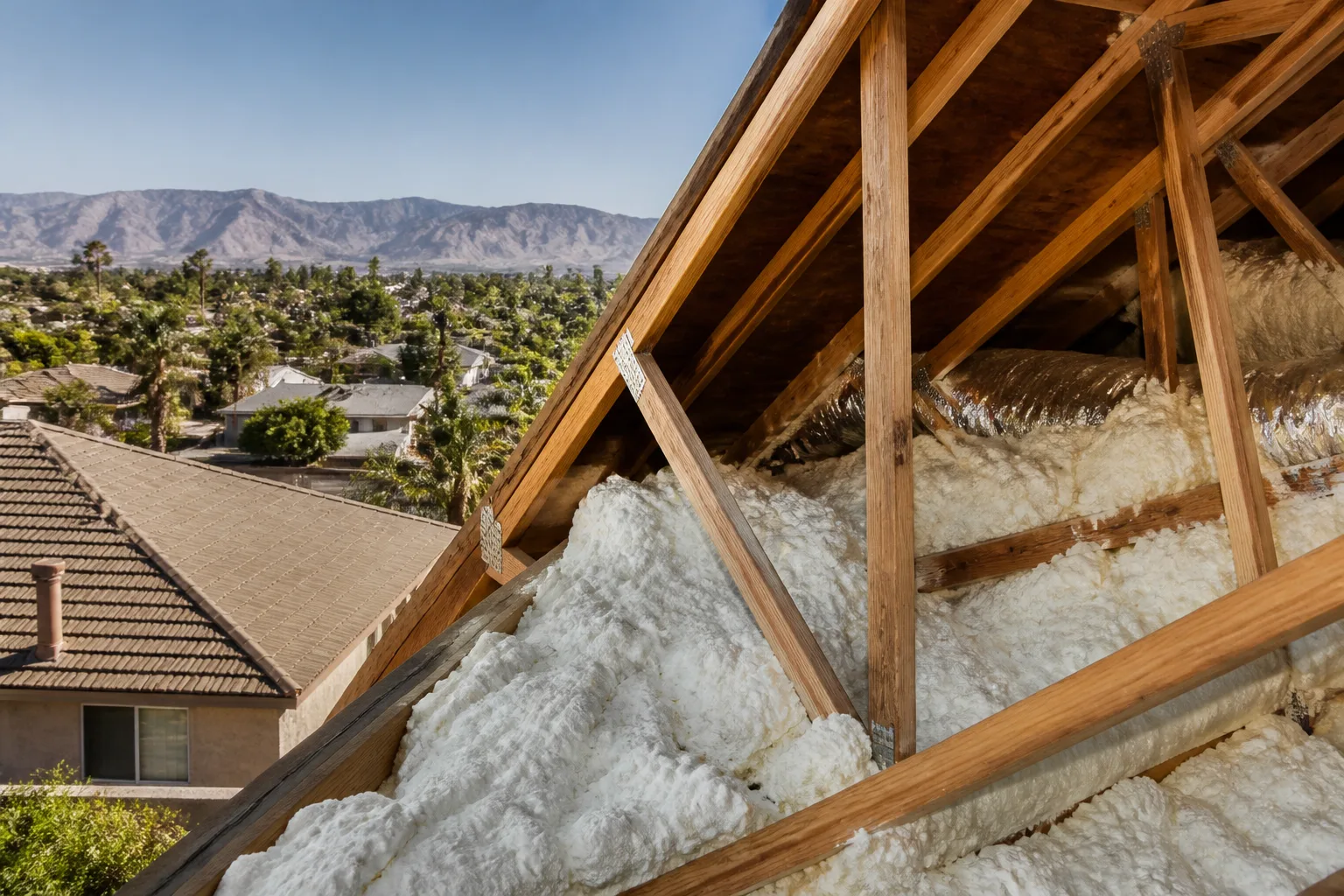
That’s where a Demilec closed-cell unvented attic conversion changes the math. Closed-cell foam applied directly to the underside of the roof deck brings the attic inside the building envelope. The thermal boundary shifts from the attic floor to the roof line. Your ducts now live in conditioned space. The attic that was 130°F drops to within 5 to 10 degrees of the living space below.
The Rialto-specific numbers: a 1,800-square-foot single-story with R-6 flex ducts in the attic routinely loses 25 to 35 percent of its cooling energy to duct and attic heat gain. An unvented Demilec closed-cell attic at R-21 (roughly 3 inches) eliminates most of that penalty. Our energy-use comparisons on Rialto homes with this configuration show cooling-season drops between 18 and 28 percent after conversion. The payback on a $12,000 to $16,000 roof deck foam job lands around 5 to 7 years at current Inland Empire electricity rates, and it extends the life of the HVAC equipment because the system runs shorter cycles against a smaller heat load.
This is the application where Demilec justifies its premium. If your ducts live in the attic, you’re not choosing between insulation materials. You’re choosing between paying to cool your attic or not.
Honest Cost Comparison: Demilec vs. Blown Fiberglass and Cellulose in Rialto
Let’s look at real numbers for a typical Rialto ranch house with an accessible attic floor of about 1,600 square feet and no ducts above the insulation line.
- Blown fiberglass (R-38): $1.20 to $1.80 per square foot installed. Total: $1,900 to $2,900. Effective air sealing requires separate work.
- GreenFiber cellulose (R-38 dense-pack): $1.50 to $2.25 per square foot installed. Total: $2,400 to $3,600. Cellulose performs better than fiberglass in high heat because its density resists convective looping within the insulation layer.
- Demilec open-cell foam at the attic floor (R-21, roughly 5.5 inches): $2.50 to $3.75 per square foot. Total: $4,000 to $6,000. Air-seals as it installs, but only reaches R-21 without a second layer.
- Demilec closed-cell at the attic floor (R-21, roughly 3 inches): $3.50 to $5.50 per square foot. Total: $5,600 to $8,800. Air-seals, adds structural rigidity, and blocks vapor drive in both directions.
What jumps out: for an attic floor with no ducts above it, a dense-pack cellulose job at R-38 delivers better raw thermal resistance than open-cell foam at R-21 for roughly half the installed cost. Cellulose also settles into a monolithic layer that stops air movement, which is the main gap fiberglass leaves open. Unless the attic floor has irregular joist spacing, can lights, or inaccessible corners where cellulose won’t pack evenly, foam at the floor rarely wins on pure payback math.
We recommend Demilec foam on the attic floor when the homeowner wants to encapsulate an existing rodent or moisture problem, when the attic hosts mechanical equipment mounted above the floor, or when the roof deck isn’t a candidate for conversion. Otherwise, blown-in insulation in Rialto using dense-pack cellulose typically makes more sense for the dollar.
Where Demilec Foam Is Overkill (And What We Recommend Instead)
Rialto is a heat-driven market. Winter heating costs are modest, and summer cooling dominates the bill. That means your insulation decisions should optimize for heat resistance and air sealing, not necessarily the maximum possible R-value per inch.
A classic overkill scenario: a 1960s track home with a simple gable attic, no ducts above the insulation, and an existing layer of settled fiberglass or rock wool. The homeowner calls wanting “the best” attic insulation and arrives convinced that spray foam is the answer because a neighbor got foam somewhere. In this house, a dense-pack GreenFiber cellulose lift over the existing insulation achieves about 90 percent of the performance of spray foam at 50 percent of the cost. We’ll tell you that directly, because we carry both materials and don’t care which one leaves the truck for any given job.
There’s also a comfort argument for cellulose in these older homes: it has a higher specific heat than foam, meaning it absorbs and releases heat more slowly. That lag effect reduces the peak attic temperature the living space feels in the late afternoon, which is when Rialto cooling load peaks. Foam insulates better per inch, but cellulose buffers better over a hot afternoon. For a home that’s unoccupied during the day and only needs comfort from 5 p.m. onward, that buffering behavior saves more on the bill than an equivalent R-value in foam.
The cases where we still steer toward Demilec: second-story additions with knee-wall attic spaces where fiberglass batts won’t stay in place, attics with complex roof geometry that can’t be air-sealed reliably with loose fill, and any attic in a new addition where the city requires a conditioned attic for compliance. Rialto’s building department enforces Title 24 energy provisions, and a conditioned attic spec on new work often makes Demilec the clearest path to sign-off.
What to Verify on a Demilec Installation in Rialto
If you’ve decided Demilec is the right call for your attic, the installation quality matters more than the brand on the drum. Foam is unforgiving of rushed work, and a bad closed-cell install is worse than no foam because it’s expensive to remove.
Three things to verify before the crew packs up:
- Thickness matches spec. Closed-cell Demilec needs a minimum of 2 to 3 inches on a roof deck to deliver its labeled R-value and act as the air and moisture barrier it’s specified to be. Uneven passes leave thin spots that become condensation points. We check every pass with a depth gauge, and you should see the same if you do a walkthrough.
- Respect the open time between passes. Closed-cell foam generates heat as it cures. Putting a second and third pass on too fast traps excess heat inside the layer, which can cause shrinkage, cracking, and a failed adhesive bond. Demilec specifies minimum wait times between passes, often 5 to 15 minutes depending on ambient temperature and humidity. A crew trying to finish a Rialto attic by noon on a hot day may be tempted to rush this. Don’t let them.
- Substrate prep. Foam doesn’t stick to dust, loose debris, or glossy surfaces. The roof deck or attic floor needs to be clean and dry before spraying. On older Rialto homes with decades of dust settled on the rafters, a vacuum pass is non-negotiable. Skipping it causes delamination within the first seasonal cycle.
We’ve pulled apart a failed foam job in a home near the Rialto airport where the previous contractor shot three passes of closed-cell without waiting between them. The core had honeycombed and pulled away from the deck within six months. The homeowner paid twice: once for the first install, once for us to remove and redo it. That’s the expensive way to learn that foam installation is a craft, not a paint job. If you’re at the point of getting quotes, ask each contractor how they verify pass thickness and cure time. If you get a vague answer, keep looking or call Birch Insulation home for a straight answer.
Low-Temperature Performance: Why Rialto Nights Matter
Rialto gets proper desert-edge cold snaps. December and January overnight lows drop into the high 30s, and a clear winter night radiates heat out of the attic fast. Two-part spray foam cures through an exothermic reaction, and that reaction behaves differently at 38°F than at 75°F.
Demilec’s closed-cell formulations carry a low-temperature application rating that many off-brand foams don’t match. In practice, that means a Demilec install in December is less likely to suffer from poor cell structure, low yield, or adhesion failure than a budget foam shot under the same conditions. For Rialto homeowners who can’t wait until spring to address a failed insulation layer, specific low-temperature capability is worth paying for. It’s not a marketing line; it’s a chemical property that shows up in the cured foam’s density and compressive strength.
Open-cell Demilec also handles cold nights differently than closed-cell. Open-cell allows some vapor diffusion, which in Rialto’s dry climate is rarely a problem. Closed-cell, by contrast, is a true vapor barrier. On an unvented roof deck, that’s what you want: it prevents warm interior air from condensing against the cold underside of the roof sheathing during a January night. The condensation risk on unvented attics in Rialto isn’t from rain; it’s from interior humidity meeting a cold deck. Demilec closed-cell stops that contact entirely.
Demilec vs. Icynene: The Comparison We Get Asked Most
We carry both Icynene and Demilec spray foam in Rialto, so we answer this question without a dog in the fight. Both manufacturers produce open-cell and closed-cell formulations that meet or exceed building code when installed correctly. The differences are in spec sheets, not real-world performance for most residential attics.
Icynene’s open-cell foam (their Classic and ProSeal lines) is softer and more flexible after cure, which some installers prefer for complex roof geometry where movement is significant. Demilec’s open-cell cures slightly firmer and holds its shape better on vertical surfaces like gable walls and knee-wall cavities. For most Rialto attics, the choice between the two comes down to installer familiarity, price, and availability, not performance. We’ll quote both and explain the trade-off in plain terms, because the homeowner should understand why a specific material lands on their roof.
Where Demilec earns a specific mention: their Heatlok HFO closed-cell line uses a blowing agent with a lower global warming potential than older formulations. For Rialto homeowners who think about embodied carbon and long-term environmental impact, that chemistry matters. It’s one of the reasons Demilec remains a staple in our lineup alongside Icynene rather than a replacement for it.
When to Call a Pro (And Why This Isn’t a DIY Weekend)
Spray foam insulation is not a homeowner project. The material is a two-part chemical that expands and cures in seconds, produces heat during cure, and requires respirators, protective suits, and calibration equipment. An improperly mixed or applied batch releases off-gassing, fails to cure, and can require complete removal. The cost of professional removal and reinstallation after a botched DIY foam job typically exceeds the cost of hiring a competent contractor the first time.
If your attic project involves the roof deck, existing electrical wiring, or recessed can lights, stop at the planning stage and call (866) 511-7592. We’ll assess whether Demilec foam, attic insulation in Rialto, or a blown-in approach is the right material for your specific house. A professional assessment costs you nothing and prevents the expensive mistakes that show up in our tear-out work.
Related services in Rialto: we handle attic insulation, blown-in, and spray foam in-house, including Demilec and Icynene spray foam applications. No subcontracting, no mystery crews.
The Bottom Line
Demilec attic insulation in Rialto is the right call when your ducts live in the attic or your roof geometry can’t be effectively air-sealed with loose fill. In those cases, the unvented attic conversion or the foam’s air-sealing capability pays for itself through energy savings and HVAC longevity. Demilec is not the right call when you have a simple attic floor with no ducts above it: dense-pack cellulose reaches higher R-values at roughly half the installed cost and buffers Rialto’s afternoon heat more effectively.
The material matters less than the match. Our position at Birch Insulation is that the home’s construction, the duct configuration, and the homeowner’s budget should decide the insulation, not the other way around. We carry eight manufacturers, Demilec among them, specifically so we can make that call honestly. If you’re in Rialto and need help, Birch Insulation offers free estimates, call (866) 511-7592.
Frequently Asked Questions
Demilec spray foam is worth the cost when your HVAC ducts run through the attic, since foam at the roof deck brings the ducts into conditioned space and eliminates most duct-related energy loss. For attic floors with no ducts above, blown-in cellulose at R-38 costs about half as much and delivers roughly 90 percent of the real-world performance. Call (866) 511-7592 and we’ll tell you which applies to your home.
Current code for a conditioned attic in California typically calls for R-22 to R-30 at the roof deck, which translates to about 3 to 4 inches of Demilec closed-cell foam at R-7 per inch. We verify thickness on every pass with a depth gauge and recommend confirming your contractor does the same.
Yes. Demilec’s closed-cell formulations are rated for low-temperature application, which matters on Rialto nights that dip into the high 30s. Budget foams often lose yield and adhesion in those conditions, so if your install window is December or January, Demilec’s low-temperature chemistry is a specific reason to choose it.
Properly installed Demilec spray foam lasts the life of the home, with no settling, sagging, or R-value loss over time. The failure points are always installation errors: rushed passes, poor substrate prep, or improper mixing. Verify your contractor’s process and the foam will outlast the roof above it. For a free estimate on a Demilec attic installation in Rialto, call (866) 511-7592.
Written by the team at Birch Insulation, serving Rialto since 2015.
Need Insulation Help?
Call Birch Insulation — licensed & insured, here with fast after-hours help in Rialto.
(866) 511-7592